







31 Mar 2026


As a critical pillar of the future energy system, new energy storage has once again been written into China's Government Work Report this year. Within the vast storage landscape, the call to "encourage large-scale deployment of grid-forming energy storage," raised by delegates during the Two Sessions, continues to draw widespread attention and debate.
Data from the CESA Energy Storage Application Division's industry database shows that the capacity of grid-forming storage projects in China nearly quadrupled in 2025 compared with 2024, with penetration reaching 12.8% and the upward trend still accelerating — a clear sign that grid-forming storage is moving from the technological frontier into large-scale commercial deployment.
In this fast-evolving segment, how can "true grid-forming" capability effectively underpin the new power system? As a leading player in the field, has drawn on decades of technical expertise and hands-on project experience to build a grid-forming vanguard — setting the benchmark for the entire industry while safeguarding the autonomy and controllability of the new power system.

Viewed against the broader arc of the energy storage industry's evolution, the rise and rapid advancement of grid-forming technology is anything but accidental.
By the end of 2025, China's combined installed wind and solar capacity reached 1,840 GW, surpassing thermal power for the first time to become the country's single largest source of electricity generation. Yet this abundance of renewable — with their high penetration and heavy reliance on power-electronic interfaces — has introduced structural headaches: the power system increasingly suffers from low inertia and weak damping. Conventional storage solutions have largely been "grid-following," functioning like players who passively take cues from the grid's voltage and frequency.
What if renewable-energy equipment could actively build the grid instead?
Grid-forming energy storage is more like a team captain that sets the pace. Operating in voltage-source mode, it emulates the characteristics of a synchronous generator, delivering autonomous voltage establishment, frequency support, inertia provision, broadband oscillation suppression, and black-start capability. Widely recognized as the linchpin for solving grid-stability challenges posed by high renewable penetration, grid-forming storage is the key enabler for renewable' transition from supplementary to dominant energy source.
Globally, grid-forming technology has undergone decades of iterative development; in China, it stands at the inflection point between technical validation and large-scale roll out. Even as deployment accelerates, formidable hurdles remain — system longevity and reliability, higher upfront costs and O&M demands, inconsistent industry standards that blur the definition of grid-forming capability, and an immature testing and certification framework. Whoever clears these barriers first will command the high ground.
Backed by 38 years of accumulated expertise in power electronics, Kehua Tech was among the earliest companies to commit to grid-forming storage. While the technology was still confined to laboratories and small-scale pilots elsewhere, Kehua had already embarked on core algorithm R&D for virtual synchronous generators (VSG) and completed early-stage exploration of grid-forming PCS technology.
Building on that foundation, the company seized the opportunities presented by China's carbon-neutrality targets and large-scale wind-and-solar base construction, advancing steadily year by year:
· 2021 — Launched R&D on strong-overload grid-forming black-start technology, breaking through the "passive response" limitations of conventional storage.
· 2022–2023 — Piloted 100 MW-class grid-forming projects, comprehensively validating technical reliability in real-world conditions.
· 2024 — Became the first domestic company to pass full-suite grid-forming verification testing by the China Electric Power Research Institute (CEPRI); delivered GWh-scale grid-forming storage projects.
· 2025 — Achieved a continuous engineering leap from single-unit 100 MW-class to GW-class deployment, setting a new global record for the largest single grid-forming storage project.
This progression represents a complete breakthrough — from laboratory research to gigawatt-scale engineering application — and a fully integrated chain from theory to practice. Each milestone has helped clear critical obstacles to the standardization and scale-up of grid-forming technology, firmly establishing Kehua Tech as a domestic benchmark for large-scale grid-forming deployment. The company's third-generation grid-forming PCS has now completed development, adding another key to unlocking the high-quality growth of the new power system.

Grid-forming storage is gaining momentum, but it is no empty buzzword or passing fad. Industry insiders agree that only genuine technical strength can truly support grid stability — software defines a system's grid-forming "identity," while hardware determines its grid-forming "stamina." So how did Kehua Tech stake out an early position, and what has driven its successive breakthroughs?
Rather than pursuing blind hardware-topology innovation, Kehua Tech has advanced through VSG-centric software algorithm upgrades paired with targeted hardware optimization — notably boosting IGBT capacity and overload capability — while continuously validating and refining its grid-forming technology across a wide range of real-world scenarios. Core capability, key technology, and overall cost-effectiveness together form the backbone of "true grid-forming."
Core Capability. Kehua's grid-forming storage systems deliver voltage and frequency support, fast frequency regulation, oscillation suppression, and weak-grid adaptability, along with black-start functionality in full-blackout conditions. These capabilities make renewable more "grid-friendly" and elevate storage from a mere auxiliary device to a core pillar of grid security and flexibility — unlocking value across peak shaving, frequency regulation, reserve, and grid restoration scenarios.
Key Technology. Through optimized VSG algorithms that emulate synchronous-generator behavior, Kehua's systems proactively supply inertia support, frequency regulation, and voltage support to the grid. Its grid-forming storage converters deliver fault ride-through, black-start, and active/reactive power stability while sustaining robust 3× overload operation. The systems feature millisecond-level power response and microsecond-level voltage establishment, with fault recovery compressed to within 100 ms and a minimum short-circuit ratio as low as 1.015 — all adaptable to a wide variety of complex grid conditions.

Cost Control. Leveraging full-stack in-house R&D, highly integrated system design, and meticulous whole-lifecycle management, Kehua Tech's cost advantage extends beyond equipment pricing to create incremental value for the grid itself. For example, its 3× overload capability allows seamless integration with existing relay-protection schemes, eliminating the need for large-scale infrastructure upgrades and thereby reducing total deployment costs.
Solving voltage stability to ensure power "gets out"; solving frequency stability to ensure the grid "holds up"; addressing broadband oscillation to keep the grid "quiet"; standardizing grid-forming adaptability to make integration "smoother"; and resolving system recovery after grid faults to make the grid more resilient — these are the coordinates that Kehua Tech, as a trailblazer, has charted first. Through closed-loop validation spanning equipment R&D, technical verification, and full-station application, the company has drawn a roadmap for those who follow.
Notably, at the 14th Beijing International Energy Storage Summit and Exhibition, Kehua Tech will unveil its next-generation high-power grid-forming storage solution and showcase multiple upgraded grid-forming converter products, further refining algorithm performance and scenario adaptability to deliver a more advanced and reliable offering for stable power-system operation and efficient renewable-energy integration.
Round after round of technological iteration must ultimately be proven in the field.
From microgrids and isolated networks to large-scale storage stations, Kehua Tech's grid-forming technology has been battle-tested across projects of varying scale and scenario, achieving deployment from the equipment level all the way up to GW-scale plant level. Projects span multiple regions of northwestern China, Inner Mongolia, and Ningxia domestically, as well as markets in Europe and Central Asia — covering weak-grid, off-grid, and multi-energy complementary scenarios, and delivering stable grid-forming performance in harsh conditions including extreme cold, high altitude, and severe sandstorms.
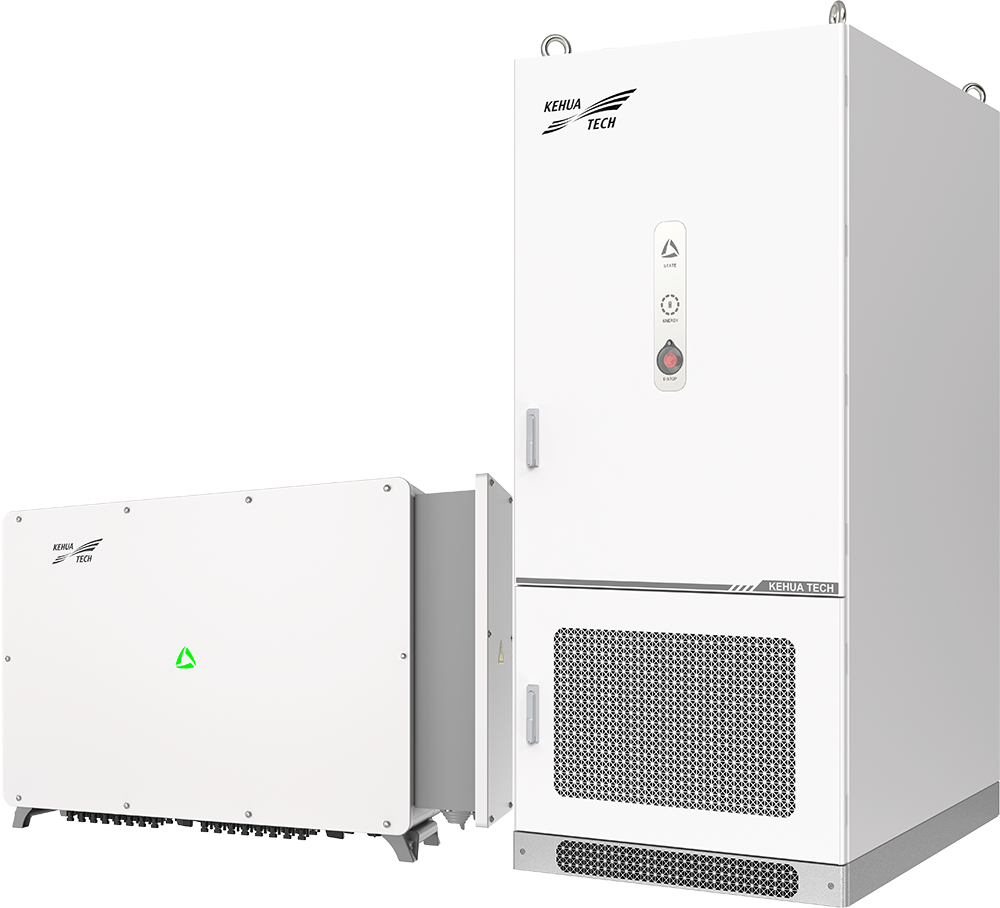
Inner Mongolia, Arongqi — 1 GW / 4 GWh grid-forming storage station. China's largest grid-forming storage installation, where Kehua's 5 MW grid-forming centralized PCS all-in-one solution has set the GW-class benchmark for grid-forming technology deployment.
Northwestern China — 300 MW / 1,200 MWh grid-forming independent storage project. The world's largest grid-connected single-site LFP grid-forming storage station, establishing a GWh-class application model and winning a CEC (China Electricity Council) Innovation Case Award.
Northwestern China — 60 MW / 300 MWh grid-forming independent storage project. Operating reliably at an altitude of 4,280 meters and temperatures as low as −36.7 °C, this project validated equipment performance under extreme environmental conditions and cracked the code on grid stability in harsh terrain.

Beyond these flagships, the Ningxia Minning 100 MW / 200 MWh project pioneered a "grid-forming + grid-following" hybrid control approach; the Inner Mongolia Tongliao 60 MW / 240 MWh project successfully demonstrated grid-forming reliability in a scenario with no grid dependency; an Iraq solar-storage-diesel microgrid became a showcase project for the Iraqi Ministry of Oil and Ministry of Electricity under the Belt and Road Initiative; and a 20 MW microgrid in Pakistan achieved efficient coordination between diesel generators and energy storage systems.
From high-altitude plateaus to vast grasslands, from sweeping deserts to fertile river valleys, from the domestic market to overseas deployment, Kehua Tech has validated the reliability of its grid-forming technology with over 4 GW of grid-forming storage installed and more than 400 microgrid systems delivered — turning grid-forming from an option into a necessity.
Industry forecasts project that by 2030, the global grid-forming storage market will grow to 72.5 GW with penetration rising to 55%. As the world's largest storage market, China's grid-forming storage capacity is expected to reach 30 GW, accounting for roughly 40% of new energy storage. Throughout this expansion, industry leaders like Kehua Tech will continue to provide essential support for solving the stability challenges of high-penetration renewable grids, while driving the standardization of grid-forming technology through real-world practice — delivering replicable, scalable solutions for the broader industry.
Looking ahead, grid-forming storage will evolve from following the grid to actively supporting it — a significantly higher bar. In step with this shift, Kehua Tech will deepen its grid-forming R&D, advance iterative upgrades of its grid-forming PCS, strengthen collaboration with research institutions and grid operators, and refine core technologies such as multi-unit parallel control. At the same time, the company is accelerating its global grid-forming footprint, tailoring solutions to policy requirements in Europe, the Americas, Southeast Asia, and other overseas markets — driving grid-forming storage deployment across an ever-wider range of complex scenarios and contributing to the global energy transition and grid stability.