






28 Jan 2026


Mission-Critical Power Protection in the AI Era: How KEHUA TECH’s Megawatt-Class UPS Powers Next-Generation Computing
With the explosive growth of artificial intelligence and large-scale models, computing power has become the new strategic resource of modern data centers. As AI workloads continue to scale, the demand for power infrastructure that is both highly reliable and extremely dense is growing at an unprecedented pace.
According to the Uptime Institute, a data center outage lasting just 60 seconds can result in average direct losses exceeding USD 50,000. For AI clusters, power instability does not merely interrupt services — it leaves high-value AI accelerators idle, severely impacting overall return on investment.
Against this backdrop, the industry is facing prominent bottlenecks that restrict the development of AI data centers:
Ø Power density VS reliability trade-off: Traditional UPS systems sacrifice reliability when pursuing higher power density, leading to increased failure risks.
Ø Parallel module operation risks: Multi-module parallel setups trigger circulating current issues, which raise system complexity and fault probabilities.
Ø Thermal management challenges: Ultra-high-density UPS generates concentrated heat, which is difficult to dissipate and affects component lifespan.
Ø Inability to match AI load characteristics: AI workloads have pulsed high-overload features, and conventional UPS lacks sufficient dynamic response capability.
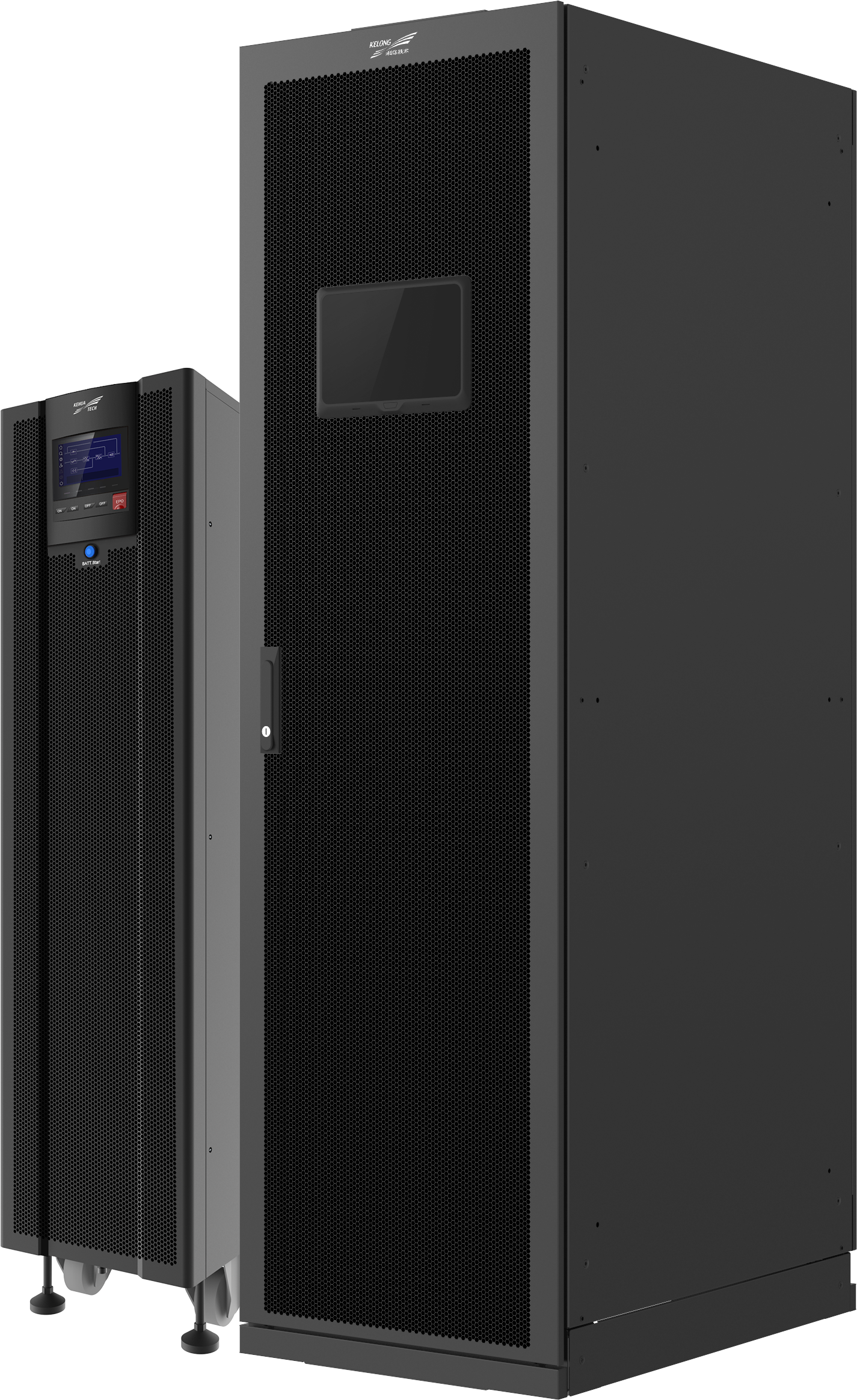
To address these pain points, KEHUA TECH has developed the MR33 Series 1.2 MW UPS (Generation 9.0). This megawatt-class uninterruptible power system is tailor-made for AI-driven data centers. It takes ultra-high power density and extreme reliability as core design goals, providing a stable power foundation for intelligent computing facilities worldwide.
Pushing the Limits of Power Density without Compromising Reliability
The core design philosophy of the MR33 Series 9.0 is "less complexity, higher reliability". It breaks the industry's inherent trade-off between power density and reliability.
Ø Strict full-lifecycle component management
(1) The selection, production, and traceability of all components are subject to rigorous quality control.
(2) The design follows FIT and MTBF reliability principles to ensure each part meets high-standard operational requirements.
Ø Simplified module structure design
(1) The design optimizes module architecture and reduces the number of parallel modules.
(2) It achieves a 57% reduction in switching devices per unit compared with traditional products.
Ø Significantly reduced failure rate
(1) The reduction in component count directly cuts potential failure points.
(2) The system failure rate is lowered by 47.2%, establishing reliability as the core competitiveness.

[Internal power module architecture optimized for reduced component count]
Minimizing Parallel System Risk through Digital Intelligence
Modular UPS relies on parallel operation to achieve high power ratings. Studies from the University of Maryland’s Reliability Engineering Center show that increased parallel modules lead to sharp rises in system complexity and failure risks, mainly due to circulating current problems in N+1 redundancy designs. The MR33 Series 9.0 solves this problem through two core measures:
Ø High single-module power density reduces parallel quantity
(1) The single-module power density of the MR33 Series is significantly improved.
(2) Building a megawatt-scale system requires far fewer modules, fundamentally reducing parallel operation risks.
Ø Proprietary high-precision digital circulating current control technology
(1) The system continuously monitors voltage amplitude and phase of each module in real time.
(2) It actively suppresses circulating currents, keeping them below 5% during parallel operation, which is far lower than the industry average.
Ø Enhanced redundancy design with intelligent fault isolation
(1) The system is equipped with intelligent fault detection and isolation functions.
(2) When a single module fails, it can be quickly separated without affecting the operation of other modules, ensuring uninterrupted power supply.
Thermal Management for Ultra-High-Density UPS Systems
ASHRAE guidelines point out that increased power density will lead to a disproportionate rise in heat flux, which directly affects component lifespan and system reliability. The MR33 Series 9.0 has a power density of 1.5 MW/m² with an occupied area of only 0.8 m², far exceeding industry standards. Its three-layer thermal verification methodology ensures stable operation under high-density conditions:
Ø Module-level independent thermal zone management
(1) Each 200 kW power module is divided into independent thermal zones.
(2) The intelligent fan speed algorithm dynamically adjusts airflow according to real-time temperature data, ensuring sufficient thermal margin even during load spikes.
Ø Core heat source targeted heat dissipation
(1) High-density fin heat sinks with optimized spacing are adopted for core heat-generating components.
(2) The airflow-guiding surface structure maximizes heat dissipation efficiency in limited space.
Ø System-level three-dimensional airflow design
(1) The system adopts three-dimensional airflow combined with strict hot and cold air isolation technology.
(2) Cooling air is accurately delivered to high-heat areas, and hot air recirculation is completely eliminated, ensuring overall system temperature stability.

[Three-dimensional airflow and hot/cold air isolation design]
Designed for the Unique Power Characteristics of AI Workloads
IDC research shows that large-model training workloads have pulsed high-overload characteristics. Power demand can surge from partial load to well above rated capacity within milliseconds. This places high requirements on UPS overload capacity and dynamic response speed. The MR33 Series 9.0 takes peak-to-average power ratio as the core design baseline, perfectly matching AI load characteristics:
Ø Third-generation semiconductor device application
(1) The system uses high-performance third-generation semiconductor devices.
(2) Their voltage and current tolerance is 2–3 times that of traditional silicon devices, enabling reliable handling of pulsed overload conditions.
Ø Enhanced thermal redundancy for heat shock resistance
(1) The thermal management system has enhanced redundancy design.
(2) It can buffer the instantaneous heat shock caused by load surges, preventing component overheating failure.
Ø High-bandwidth digital control algorithm for rapid response
(1) The upgraded high-bandwidth digital control algorithm achieves millisecond-level detection and response to load changes.
(2) Third-party testing confirms that the MR33 Series supports more than 150% overload for 300ms, fully meeting the standards for voltage transient range and recovery time.

[The peak-to-average power ratio of AI cluster loads vs. typical IT loads]
A Reliable Power Foundation for the AI Era
The MR33 Series 1.2 MW UPS (Generation 9.0) has passed rigorous validation tests, including high-low temperature testing, high-humidity testing, seismic testing, and thousands of hours of aging tests.
In the AI era that is reshaping the digital world, power infrastructure determines the upper limit of digital innovation. KEHUA TECH’s megawatt-class UPS solutions provide continuous and reliable power support. They enable data centers and intelligent computing facilities to scale with confidence and reliability into the future.